
Despite their intention to craft unique identities, some names have been reused by different manufacturers. Importantly, these cases do not include vehicles that have merely been rebranded with a new logo, such as the Buick/Opel Cascada; we are highlighting names that have been independently adopted by unrelated automakers.
There are various reasons behind this phenomenon. A notable instance is the Pontiac GTO, which was named with the intention of invoking the legendary performance of the Ferrari GTO. In other cases, the names may be inspired by geography or vehicle body types, or they may have lain dormant long enough that modern consumers are less likely to confuse them with existing models. Regardless, these are a few vehicle names shared across different manufacturers.
California

When the name “California” comes up in discussions about sports cars, Ferrari is often the first brand that springs to mind. The name debuted in 1957 with the 250 California, produced until 1963, while the 365 California was introduced in 1966 but only saw 14 units built within that year. This title was chosen to evoke the allure of California’s scenic drives, appealing to the American market.
Ferrari reintroduced the California name in 2008, simplifying it to just “California.” This version maintained the 2+2 convertible design but added a hard-top roof and was noted as the first V8 road car from Ferrari to feature a mid-front layout aimed at enhancing performance and handling.
Conversely, Volkswagen introduced its own California model in 2005, but in stark contrast to the sleek sports car, this vehicle is a campervan derived from the VW Transporter. Ironically, despite its name referencing a U.S. state, the Volkswagen California was never available for purchase in the United States. The closest alternative now is the VW ID. Buzz, which, while a pleasant passenger vehicle, lacks essential camping features like a kitchen sink.
Century

The Century name is predominantly associated with Toyota, recognized as the brand’s flagship model since its launch in 1967. It remains in continuous production, albeit with just three generations and one SUV version, embodying a commitment to timeless elegance, with modern iterations still reflecting the design of the original nearly six decades ago. However, the Toyota Century is not available in the U.S., though buyers can find another version of the name here.
The American Century, from Buick, predates Toyota’s offering, having been introduced in 1936 by mating the compact Buick Special’s body with a powerful straight-eight engine. This combination led to a strong performance characteristic that earned it the nickname “the banker’s hot rod.” Buick created several iterations, with the most recent production ending in 2005.
These two Century models serve vastly different demographics; the Toyota Century emphasizes luxury and comfort, famously serving as the Japanese emperor’s official car, while the Buick Century prioritized performance. However, the latter’s last generation struggled with both aesthetics and engine reliability, which has led many enthusiasts to avoid it.
GT

The abbreviation GT stands for Gran Turismo in Italian and Grand Touring in English, describing vehicles built for high-speed long-distance travel with comfort in mind. Many manufacturers attach the GT designation to denote sportier or performance-focused versions of existing models, yet some brands have chosen to employ “GT” as an actual model name.
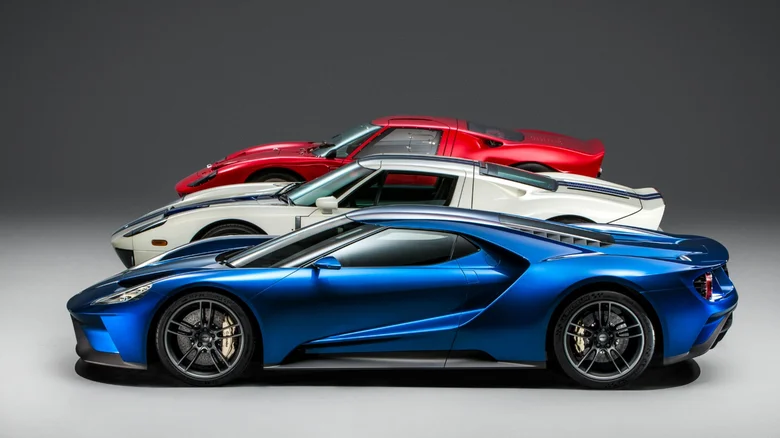
A prominent model sporting the GT badge is the Ford GT, introduced in 2004 as part of the company’s centennial celebrations, paying tribute to the famous Le Mans-winning GT40. The second generation debuted in 2017, with production concluding in 2022. While it embodies traits of a grand tourer, the Ford GT functions as more of a supercar. In contrast, the Mercedes-AMG GT maintains a balance of being one of the fastest in its lineup while providing substantial comfort.
European automakers have also embraced the GT nomenclature, including the Opel GT—a lesser-known gem from 1968 to 1973 that bore resemblance to a Chevrolet Corvette. Opel reintroduced the name from 2007 to 2010 in the form of a rebadged Saturn Sky/Pontiac Solstice. Alfa Romeo also released its own GT model from 2003 to 2010; however, it was based on a compact hatchback and failed to deliver the typical space expected from a genuine GT.
Monza

The Ferrari Monza is an intriguing model from this well-respected manufacturer, boasting features that truly capture the interest of car enthusiasts—such as its “virtual windscreen” and a singular carbon-fiber seat found in the SP1 variant. Its design pays homage to Ferrari’s racing heritage from the 1950s, complemented by an impressive 809 hp 6.5-liter V12 engine that accelerates from 0 to 62 mph in under three seconds.
Conversely, Chevrolet produced a subcompact two-door muscle car named Monza from 1975 to 1980. While not an exotic sports car, it is often overlooked as a noteworthy Chevy muscle vehicle. This model drew inspiration from the Ferrari 365 GTC/4’s silhouette and took its name from an iconic Italian racetrack.
The Chevrolet Monza had a notable presence in motorsports, favored by drag racers for its compact size and aerodynamic design. However, due to its introduction during the Malaise Era, the production models suffered from underpowered engines, leading to sluggish performance stats, taking over 13 seconds to reach 60 mph from a standstill.
Sebring

The 12 Hours of Sebring, established in 1952, may not rival the 24 Hours of Le Mans in popularity but stands as an iconic American endurance race, hence the name shared by two distinct vehicles from Chrysler and Maserati. Maserati’s Sebring, launched in 1962 to celebrate its racing success at the Sebring event, enjoyed production until 1968, yet only around 600 units were manufactured, making it a rarity.
In contrast, Chrysler’s Sebring ran from 1995 until 2010 as a mass-market midsize offering, engineered to compete with models like the Honda Accord and Toyota Camry. This sedan/coupe can also be had in a convertible variant for those who enjoy open-air driving. The vehicle was retired in 2011, replaced by the Chrysler 200, which was a heavily revised version rather than an entirely new offering.