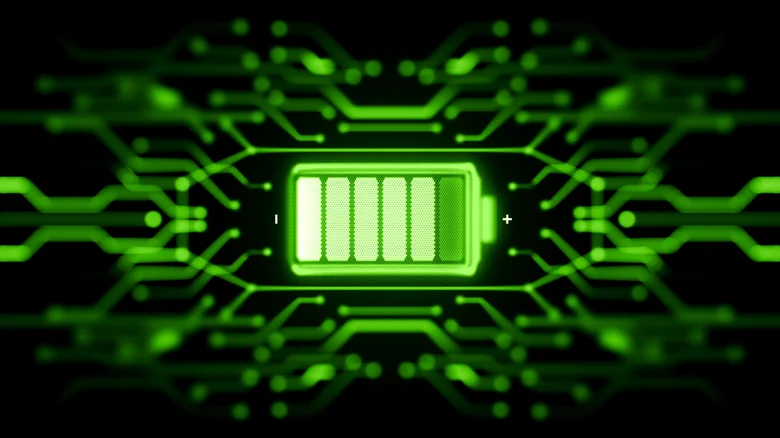
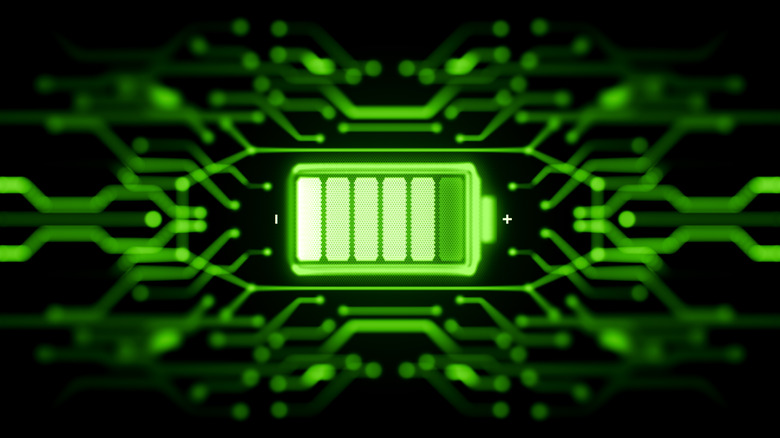
However, the primary limitation of batteries is their finite lifespan. Even smartphones renowned for their battery longevity typically require recharging within one or two days. This consistent cycle of discharge and recharge eventually leads to battery degradation, causing frustration as devices fail to hold a charge as effectively. A Chinese firm is challenging this norm.
In January 2024, BetaVolt revealed its innovation: a nuclear battery that reportedly lasts for 50 years without needing a recharge. Named the BV100, this coin-sized device utilizes nickel-63 to produce 100 microwatts at 3 volts. The company is also set to introduce a more powerful 1-watt version in 2025, although its progress remains unclear. Reports indicate that the BV100 went into mass production in 2025. Let’s explore its functioning and consider the potential limitations of the BV100.
The Mechanism Behind a Nuclear Battery
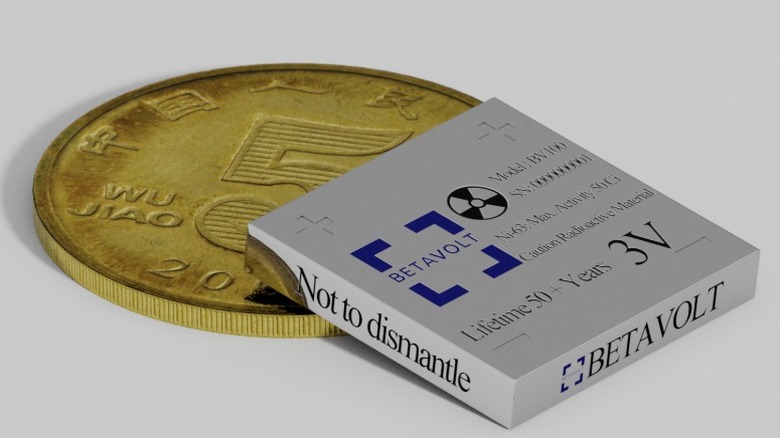
The BetaVolt BV100, while exciting, is not the first radioactive battery developed. In late 2024, for instance, researchers from the University of Bristol introduced the pioneering carbon-14 diamond battery, boasting an estimated lifespan of thousands of years. However, this innovation came well after earlier cycles of research, including RCA’s atomic battery from 1954. Additionally, in 1961, the U.S. Navy’s Transit 4A and 4B satellites operated using nuclear batteries, specifically radioisotope thermoelectric generators (RTGs).
The underlying principle of nuclear batteries is straightforward. They exploit the decay of radioactive elements to generate electricity over extended periods. RTGs utilize the Seebeck effect to generate voltage through temperature differences stemming from radioactive decay in suitable conductors.
The BV100 employs similar core ideas, leveraging beta radiation. In this case, beta particles emitted from the nickel-63 core are captured by diamond semiconductors, which convert the emitted electrons from radioactive decay into usable electricity. Thus, the BV100 emerges as a compact battery with potential longevity of up to 50 years—all while posing minimal risk to living organisms.
Prospects for Nuclear-Powered Smartphone Batteries
The announcement from BetaVolt in January 2024 brought hopes of radically transforming smartphone usage by removing the need for recharging, and also offered the potential for longer-lasting drones. However, some experts caution against unbridled enthusiasm.
In a discussion with Live Science in 2024, materials scientist Juan Claudio Nino raised concerns regarding the BV100’s low voltage. He commented that while it could feasibly power devices such as pacemakers or passive wireless sensors, it doesn’t deliver enough power for smartphones. With just 100 microwatts generated, it’s far short of the 4,000 milliwatts a smartphone can use during a video call; thus, a nuclear battery adequate for smartphones would need to produce significantly greater energy output than the BV100 offers.
Simply increasing the size of the battery presents challenges as well, as Wired noted in 2024. Given that standard smartphones can draw up to 2 amps in use, a nuclear battery would ideally maintain a consistent output of around 1.5 amps to be effective. However, to create a BV100-style battery capable of this output for an extended period, it would require roughly 680 pounds of nickel-63. Clearly, even the most expansive smartphone designs would struggle to accommodate such a massive battery.