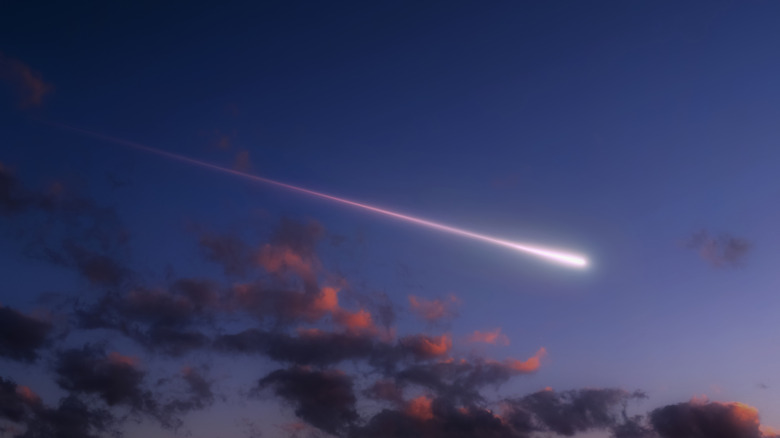
When you look up at the night sky, you might ask yourself, “What’s that?” Is it a bird? A plane? A satellite perhaps? With thousands of satellites circling Earth—over 9,000 launched by SpaceX and around 15,000 total as of January 2026—they’re certainly recognizable. However, these satellites are often confused with meteors.
Stargazing reveals much more than just stars. While many objects are easily recognizable, Alyn Wallace, a renowned landscape astrophotographer, notes that even the media can mix up satellites and meteors, despite their distinguishing features. One of the clearest differences that even casual observers can notice is their speed. Meteors blaze across the sky quickly, while satellites move at a much slower pace, making it possible for them to be captured in consecutive photographs. Meteors typically show up in just one frame, whereas a satellite will be visible in multiple.
SpaceX’s Starlink satellites are particularly simple to spot, often appearing as bright, elongated lines of lights, known as satellite trains. At times, you can observe several dozen of them moving in unison, creating what looks like a progressive white streak in the sky. If you’re still uncertain about what you’re witnessing, there are additional methods to help clarify your observations.
Distinguishing Satellites from Meteors
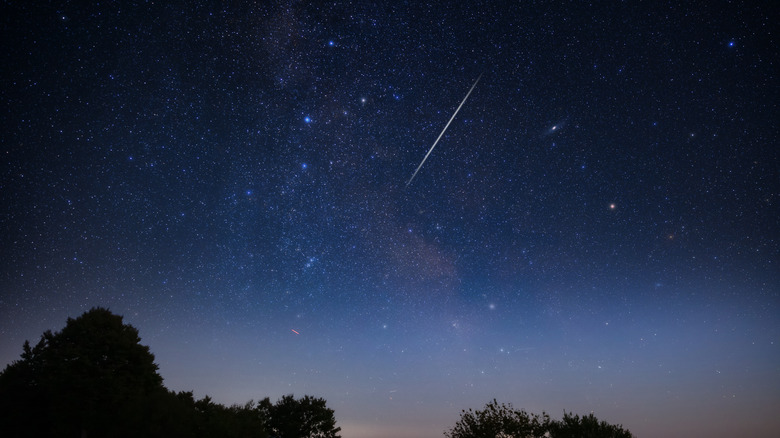
Many satellites operate within low Earth orbit (LEO), making them plainly visible. They are crucial for various facets of daily life, including communication, locating services, and navigation—essentially, we would be quite lost without them! But how can you identify that glowing object in the sky, particularly if you’re new to stargazing?
Beyond speed, the type of trail a satellite leaves differs from that of a meteor. Both produce tapered trails that taper off in thickness, but they do so distinctively. Meteor trails are typically uneven and emit bright bursts of color that fade quickly, while a satellite’s trail is more uniform and consistent in brightness, lasting significantly longer. Meteors may appear in shades of green or yellow, but satellites generally shine white or bluish-white. Notably, satellites don’t produce their own illumination; they merely reflect sunlight, which is why they’re often best seen during dawn or dusk.
Other aerial objects can often be recognized easily, especially in images. A line of dots in a horizontal array that appears across multiple photos is likely an airplane. Additionally, planes have clear exterior lights, distinguishing them from meteors and satellites, which lack such features. If you’re ever uncertain, consider using an app like Star Chart (free) or SkySafari 7 Pro (starting at $21.99)—or simply take a moment to enjoy the celestial display.