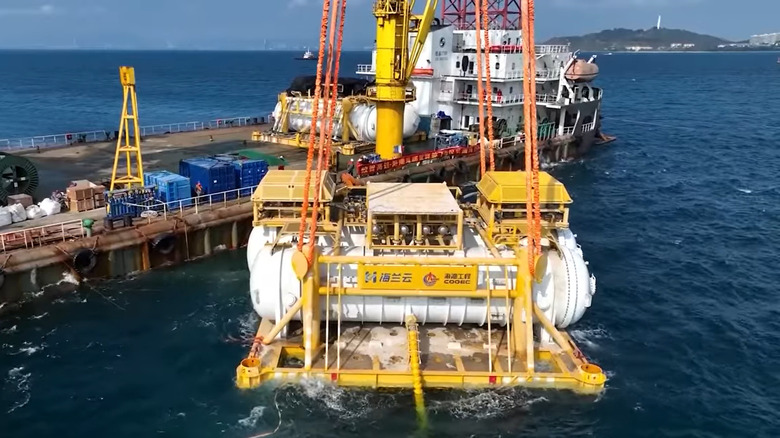
The demand for water by data centers leads to serious challenges. These facilities often consume significant quantities of drinkable water for cooling, creating competition with domestic use and agricultural needs. A feasible solution, as demonstrated by China, is to install data centers in environments rich in non-potable water, such as the ocean. While several underwater initiatives have been explored—Microsoft’s Project Natick being a notable example that wrapped up in 2020—the only currently functioning commercial underwater data center exists in Hainan Province, China.
This data center has recently commenced operation as a substantial artificial intelligence computing hub, akin to the “AI Alley” in DC. Housed within steel-enclosed capsules on the seabed near Lingshui, the center’s servers manage functionalities similar to traditional data centers—such as data processing, cloud service management, and AI training—but do so by utilizing the cooling effect of the surrounding seawater instead of relying on energy-consuming air conditioning. This transition to high-density AI computing reflects the most sophisticated phase of a project designed to enhance computing efficiency while minimizing energy expenditure and land use.
The facility isn’t entirely new. Initial underwater modules were launched back in 2022 and became operational in 2023. The addition of further modules and upgraded technology has enabled these systems to undertake more rigorous AI-oriented tasks, evolving an already functional site into a comprehensive computational hub. There is also another underwater data center being constructed close to Shanghai.
What are the environmental implications?

The beneficial environmental aspects of such an endeavor are quite evident. Traditional data centers consume substantial energy to maintain cooling systems. However, underwater data centers utilize the ambient seawater as a natural cooling source, significantly lowering energy requirements. Moreover, they have a lesser impact on human populations since they eliminate the necessity for land clearance and do not cause noise disturbances related to construction and maintenance—factors that have prompted various U.S. states to postpone the establishment of AI data centers.
Nevertheless, the ecological ramifications of these undersea installations are still being studied, and their full effects may not be completely understood at this stage. Although the surrounding water cools the data center, it leads to a minor increase in local water temperatures. Microsoft’s Natick project reported temperature variations that were localized and minimal, measured in fractions of a degree, yet even slight changes can significantly affect species sensitive to temperature. A study from the University of Johannesburg indicated potential risks to marine biodiversity, particularly concerning ocean deoxygenation. Should more underwater data centers be developed, these effects could intensify. Additionally, risks such as leaks and corrosion remain concerns.
Could marine ecosystems adapt to the presence of data center pods? Research suggests that these structures might function as artificial reefs, attracting various marine species. For instance, Microsoft’s Natick project utilized cameras to observe and document marine life near the data center. Future iterations of underwater data centers could integrate similar technologies to support marine research, though there is currently no evidence of this being applied in Hainan.