Have you ever doubted your ability to differentiate between audio cables, even though others seem confident in their judgments? A recent experiment conducted by the diyAudio community, highlighted by Headphonesty, may validate your suspicions. Participants engaged in a test where they listened to three different audio recordings made with either standard copper wire, a banana, or a tray filled with wet mud. Remarkably, most individuals were unable to distinguish between the various recordings.
In this instance, diyAudio moderator Pano introduced a selection of audio recordings to forum participants, challenging them to identify the method of capture for each track. These audio samples included various artists, such as Etta Jones and Nirvana, as well as piano pieces. Each recording was played four times: once in its original CD quality, followed by three additional re-recorded formats. These re-recordings were created using unconventional materials like a banana, a mud-filled tray, and lengths of copper wire.
Many might assume that including a banana would disturb the audio quality significantly, yet this did not seem to be the case for the majority of participants. Correct guesses seemed more like lucky accidents. While there could be qualitative differences in the recordings, they were not readily apparent.
Why is it difficult to perceive differences between a banana, mud, and copper wire?

Several factors contribute to our inability to hear differences between the audio samples. Firstly, the odd arrangement of components, while seemingly unconventional, behaves like resistors in series. This results in a relatively uniform flow of current across all components, meaning that unusual materials are less likely to introduce major audio artifacts such as electrical interference, which would typically be noticeable.
Distinguishing between recordings usually involves identifying varying noise levels or other fidelity problems. This is how one can differentiate between audio formats like vinyl and CD, for instance. However, if the technical performance of the equipment is similar, distinguishing between recordings becomes much harder.
The ability to identify differences in audio is not solely based on the qualities of the file or the equipment utilized to record it; it heavily depends on personal perception as well. Auditory perception is a complex interplay of psychological and biological factors that help us interpret sounds. Surprisingly, our senses may not be as reliable as expected—our brains often compensate for sensory gaps, leading to missed nuances in sound, particularly with familiar tracks, like those from Nirvana.
Do any differences between the audio files exist?
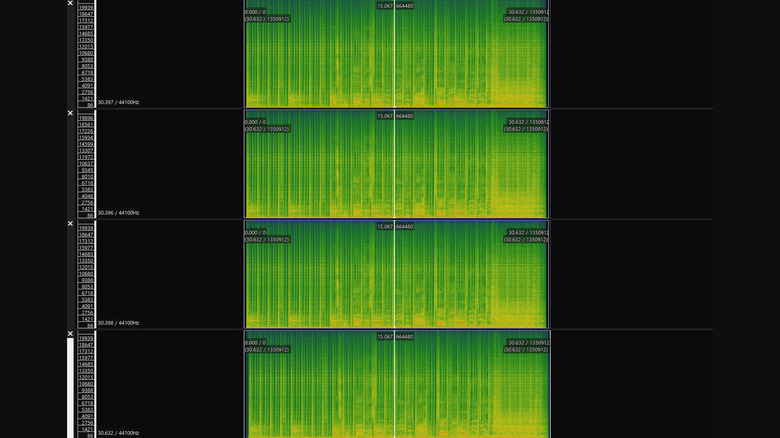
While the difficulty in perceiving differences between the experimental audio tracks does not negate their existence, it prompts a closer examination. Utilizing audio analysis software like Sonic Visualiser, we examined the tracks for any hidden variances that are not easily detectable by ear.
Contrary to expectations of visually distinct tracks based on their recording methods, the analysis revealed no significant visual discrepancies. Each of the four Nirvana tracks was compared through their spectrograms and waveforms. Spectrograms visualize audio frequencies, while waveforms illustrate sound amplification over time.
Besides a few minor deviations among the tracks—one being mono and another slightly misaligned—there were no substantial clues indicating that a banana was used for recording any of them. Spectrograms and waveforms can only provide limited insight into a sound’s characteristics, focusing primarily on loudness and frequency range. This suggests that the recordings might still retain unexamined intricacies due to their unconventional recording techniques, but these subtleties are not readily perceptible to the human ear.