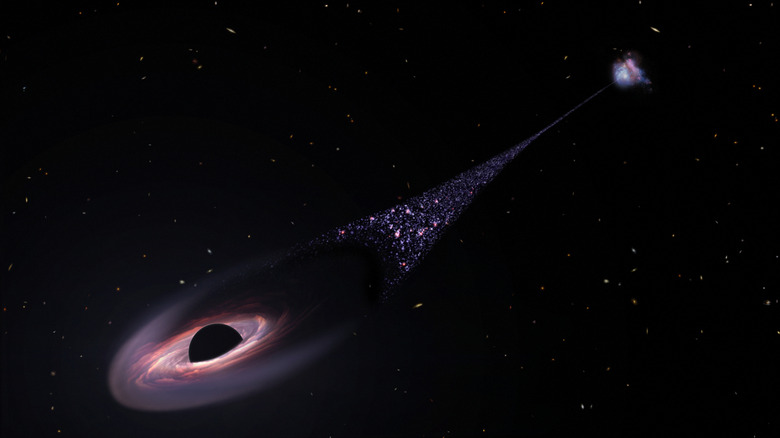
A groundbreaking discovery in astrophysics has yielded the first verified instance of a “runaway” supermassive black hole (SMBH). This celestial entity is estimated to possess a mass equivalent to 20 million suns and is racing away from its host galaxy at an astonishing speed of 2.2 million mph, leaving an immense path of stars and gas in its wake. The findings were shared by Pieter van Dokkum from Yale University and his research team through a paper titled “JWST Confirmation of a Runaway Supermassive Black Hole via its Supersonic Bow Shock,” which was posted on arXiv in December 2025.
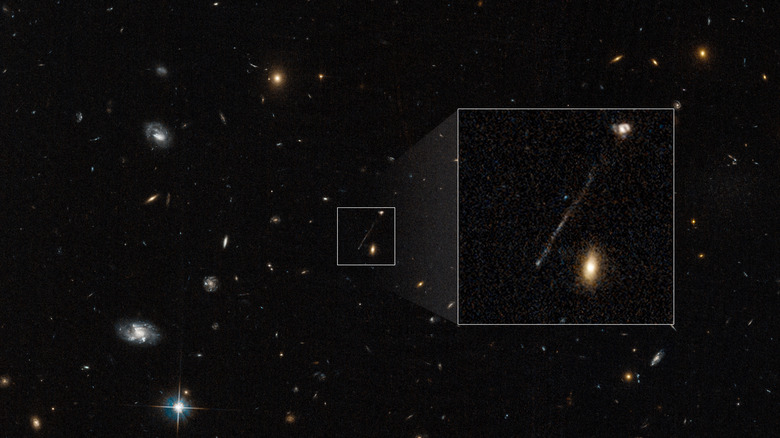
The journey to this discovery began in 2023, when Van Dokkum’s team first identified the potential runaway black hole while examining an image from the Hubble Space Telescope. They noticed an unusual thin filament linked to the center of a galaxy, leading them to surmise they were observing a significantly massive black hole that had been expelled from its galaxy, trailing a stream of gas and newly formed stars behind it. Their initial findings were published in The Astrophysical Journal Letters later that year.
However, extensive follow-up research was essential to establish that this object was indeed a runaway SMBH. This verification was accomplished using the James Webb Space Telescope (JWST), renowned for capturing some of the most breathtaking images of the cosmos to date. The JWST’s advanced imaging capabilities revealed a bow shock at the front end of the SMBH, affirming the fact that the black hole was rapidly fleeing its galaxy.
What causes a supermassive black hole to escape its galaxy?
The mechanisms behind supermassive black holes remain one of the greatest enigmas in astrophysics. While their existence is widely acknowledged and the presence of a supermassive black hole at the core of most galaxies is nearly certain, the processes that contribute to their formation and rapid expansion remain elusive. Various hypotheses have been proposed, but definitive answers are still absent.
As for the newly confirmed SMBH, the paper released in December 2025 suggests that it was propelled onto an escape trajectory due to a “velocity kick,” arising from either gravitational-wave recoil or interactions involving multiple bodies. Researchers advocate that gravitational-wave recoil is the more plausible explanation. In a conversation with Live Science, lead author Pieter van Dokkum detailed how such velocity kicks can occur when two or more supermassive black holes come close together, resulting in their strong gravitational fields altering each other’s orbits and potentially ejecting one into the cosmos.
This escaped black hole might not stand alone, as the paper also identifies several other potential candidates. Notably, a significant black hole situated in the dwarf galaxy MaNGA 12772-12704, which is positioned approximately 1 kiloparsec from the galaxy’s center, was first highlighted in a brief communication published in Volume 70, Issue 21 of Science Bulletin. Nevertheless, Van Dokkum’s group remains the only one to have verified the existence of a runaway SMBH, pending peer review.