
In 1969, the United States achieved a historic milestone by landing a human on the moon, outpacing the Soviet Union in the fiercely contested space race. This competition driven by research and technological breakthroughs not only advanced rocket science and aviation but also revolutionized fields like communications and medicine. Since then, we have witnessed significant milestones such as the creation of the International Space Station, successful rover landings on Mars, and a surge of innovation in the commercial space sector.
While the United States has ambitious plans to revisit the moon and embark on manned missions to Mars, they are not the sole players eager to venture into space. China’s private space sector is rapidly evolving, with aspirations that extend beyond just launching rockets. Once dominated by governmental entities, the commercial space initiatives in China have flourished remarkably over the past decade.
In 2022, China initiated a major shift by inviting private firms to join its space projects, accelerating its growth towards becoming a significant space force. The China National Space Administration announced an ambitious agenda in 2025 to boost the production and innovation within its growing commercial space sector over the following decade. Currently, private enterprises in China are focusing on developing reusable rocket technology, satellite systems, and even biomanufacturing capabilities.
China’s Advances in Space Exploration
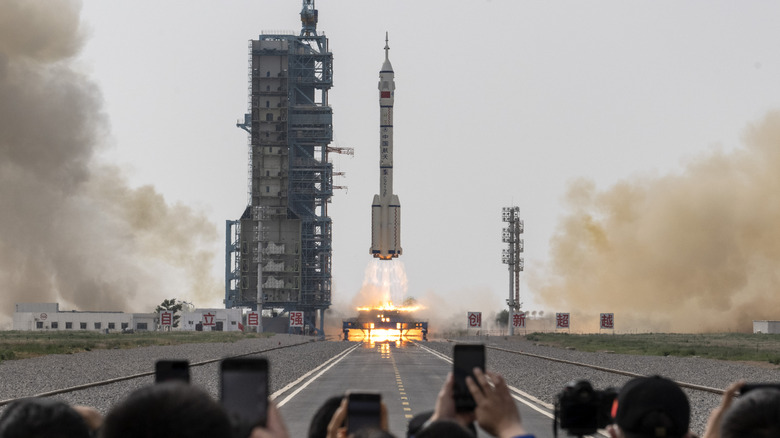
While SpaceX is prominently recognized as the leading pioneer in reusable rocket technology, China is making noteworthy progress in this area. Unlike conventional rockets that consist of multiple disposable stages, reusable rockets are designed for multiple launches. In mid-2025, a milestone was achieved by the Yuanxingzhe-1, a suborbital rocket created by Space Epoch. It successfully launched and then regained vertical landing, marking a notable first for a Chinese enterprise. Though this test did not attract widespread international media attention, it underscores a pivotal change in China’s strategy toward affordable access to space, crucial for enhancing both commercial and military capabilities.
The ability to reuse rockets could enable China to significantly expand its satellite infrastructure in low-Earth orbit. Over the next decade, as many as 54,000 satellites could be launched by five different companies, aimed at providing internet connectivity. Shanghai Spacecom is working on an ambitious satellite constellation named Thousand Sails, which includes 15,000 satellites. In comparison, SpaceX’s Starlink program features around 9,000 satellites. Airbus has recently partnered with Thousand Sails to supply in-flight internet for its aircraft. Other businesses are planning to utilize these satellites for navigation in vehicles and functions on smartphones.
Moreover, China is looking towards the realm of space tourism. In 2024, CAS Space declared that it will debut its first tourist spacecraft in 2027, accommodating seven passengers for approximately $415,000 per flight. Another entity, Deep Blue Aerospace, aspires to offer orbital trips for about $210,000 per person. Additionally, China is venturing into biomanufacturing in outer space, as evidenced by AZSpace sending yeast, plants, and probiotics into orbit.