There are growing concerns among at least four Air National Guard units in the United States as their aging F-16 Fighting Falcons are set to be retired without any immediate plans for replacement. According to Aviation Week, the units affected are located in Arizona, Colorado, New Jersey, and Texas. These Air National Guard groups typically operate under the governance of their respective states or territories, but federal control can be enacted if necessary.
The uncertainty surrounding the aircraft’s retirement is creating anxiety among the leadership of both the Air National Guard and the Air Force, indicating that removing any or all of these units from combat roles could hinder the nation’s preparedness to deploy aircraft swiftly.
The F-16A fighter jets were originally manufactured in Fort Worth, Texas, by General Dynamics, which was later absorbed by Lockheed Martin, becoming operational in January 1979. Subsequent models, including the F-16C/D Block 25-30, came online in 1981, followed by Block 40-42 in 1989 and Block 50-52 in 1994. Retiring older aircraft is a standard procedure; for instance, the typical lifespan of an F-35 fighter jet is around 8,000 flight hours, while the average service life of the F-16 fleet stands at approximately 17.2 years.
Are All F-16 Fighter Squadrons at Risk?
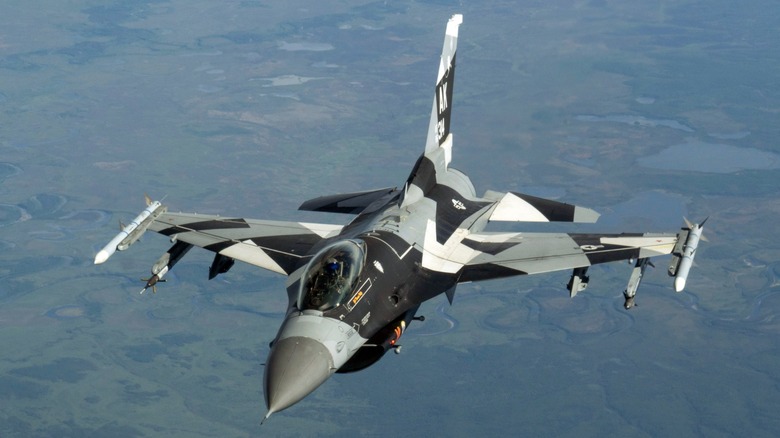
The trend of retiring aging fighter jets isn’t exclusive to the United States; Denmark is also phasing out its F-16 fleet. Nevertheless, the future looks promising for the F-16 Fighting Falcon within the U.S. Air Force and various global military forces.
As of September 2021, the U.S. Air Force reported possessing 1,017 F-16C/D fighter jets. This total is subject to change due to scheduled retirements and ongoing production by Lockheed Martin, which has delivered 37 Block 70-72 aircraft—the latest iteration of the F-16—with a backlog of 111 more set for delivery. Currently, an estimated 2,800 F-16s are in service across 29 countries, logging nearly 20 million flight hours collectively.
An official fact sheet from the USAF outlines that the primary purpose of the F-16C/D is to serve as a versatile multi-role fighter, capable of conducting missions to “strike airfields, military production sites, Scud missile launchers, and a variety of other targets” in the Persian Gulf, notably during Operation Desert Storm. Subsequent missions have taken place during Operation Allied Force and various operations following September 11, including Noble Eagle, Enduring Freedom, and Iraqi Freedom. More recently, in response to the 2026 Iran conflict, Turkey deployed six of its F-16 jets to enhance defense measures for a Turkish community in northern Cyprus on March 9, 2026.