On the morning of October 6, 1941, the SS Thistlegorm was anchored in the Straits of Gubal, located in the Northern Red Sea close to the Sinai Peninsula. Unfortunately, it found itself in peril when two Heinkel He 111 bombers, mistaken by the German Luftwaffe for an Allied troop carrier, targeted the ship. While officially transporting motor parts, the Thistlegorm was actually loaded with a variety of military supplies, including weaponry and vehicles designated for British forces in North Africa.
At around 1:30 AM, one of the Heinkels released two bombs, impacting the vessel’s fourth hold at the rear. The resulting explosion was so intense it split the ship’s hull in half and hurled two Stanier 8F locomotives, each weighing 73 tons, into the sea. The blaze that followed was so luminous it led to the identification of the nearby Rosalie Moller, which was subsequently destroyed two days later.
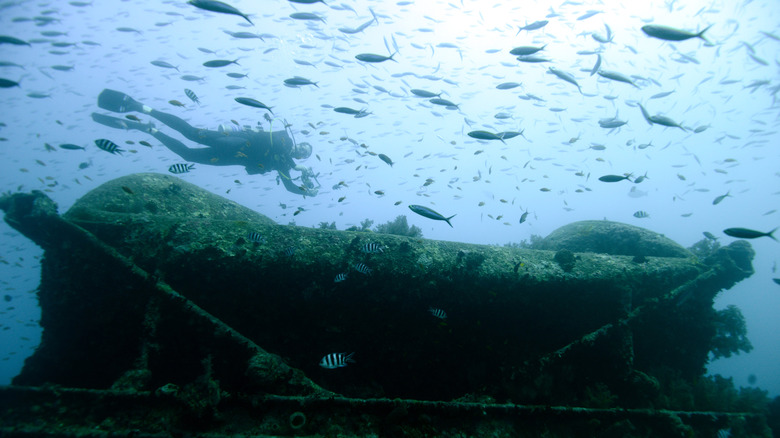
The Thistlegorm went down in a “V” formation; the rear settled on its side at approximately 105 feet underwater, while the bow remained upright at about 52 feet deep. Out of the 42 crew members, only nine perished, including five from the Royal Navy, who were likely operating the anti-aircraft systems at the stern where the initial hits occurred. Today, this site has transformed into a popular diving location, home to diverse marine life such as barracudas, stonefish, and sea turtles.
Lion and crocodile and angel (fish), oh my!

The wreck of the Thistlegorm remained relatively obscure until its rediscovery by renowned explorer Jacques-Yves Cousteau in 1955. Yet, it wasn’t until the 1990s that it gained widespread recognition as a premier diving site. Now encrusted with coral, this eerie underwater haven serves as a sanctuary for various marine species, including lionfish, batfish, moray eels, and angelfish. Among the most intriguing inhabitants is the crocodilefish, a stealthy ambush predator resembling its terrestrial namesake.
Moreover, the substantial cache of military gear that withstood the initial attack still lies undisturbed in the ship’s expansive holds, creating a sort of underwater museum. Divers can explore the site, including the two Stanier 8F steam locomotives that fell about 100 feet from the stern. However, due to the dangers of wreck diving, entry is restricted to those who have logged at least 20 dives.
The SS Thistlegorm, which translates to “Blue Thistle” in Gaelic, was constructed in 1940 by J. L. Thompson & Sons Ltd. and was part of a fleet operated by Albyn Line Co. Ltd., with partial funding from the British government. Although its service was brief, the remains of the SS Thistlegorm continue to captivate interest as one of the most remarkable shipwrecks globally.