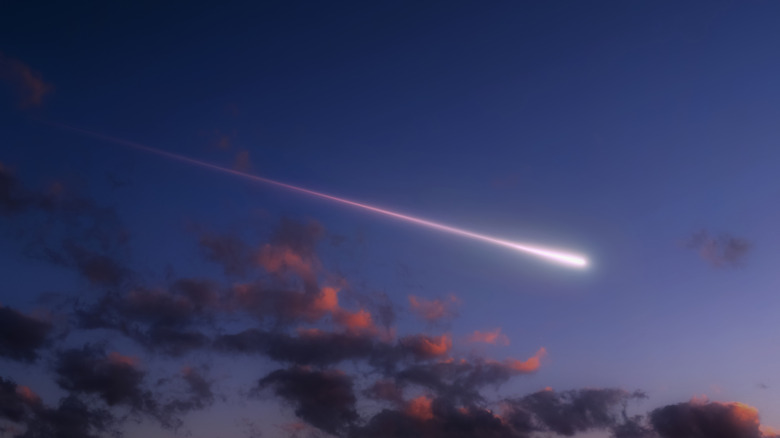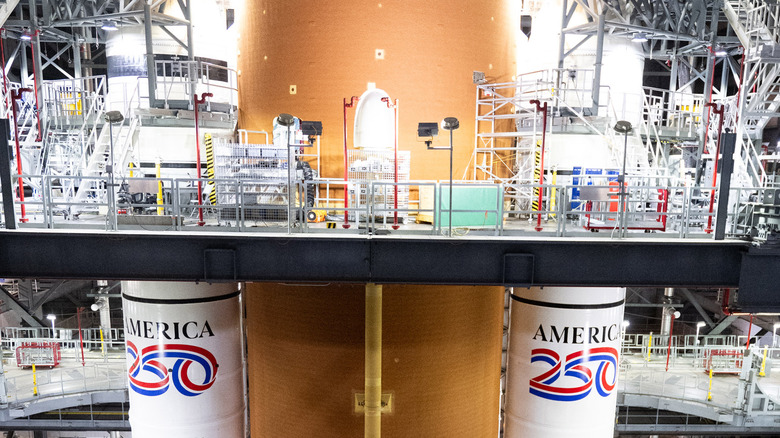
The Space Launch System (SLS) Artemis II rocket by NASA stands as a monumental achievement of human engineering, reaching a height of 212 feet, making it the largest rocket NASA has ever constructed. At launch, the SLS is expected to produce an astounding 8.8 million pounds of thrust, with around 75% of this power supplied by its twin solid rocket boosters during the initial launch phase. This showcases why space exploration remains one of the most fascinating realms of technology.
Artemis II will mark the first opportunity for humans to experience the far side of the moon since the Apollo missions concluded. This mission will send a quartet of astronauts on a round trip to the moon that will last approximately ten days. The path to having this massive rocket ready for its launch, however, has been more gradual. Each booster consists of ten segments manufactured in Utah and transported via rail for 1,600 miles across eight states to NASA’s Kennedy Space Center in Florida.
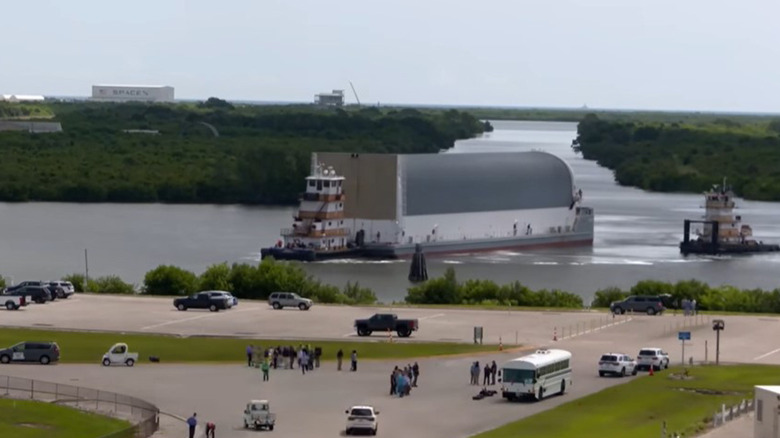
The main core stage is also moved at a measured pace, journeying by barge for over 900 miles from the Michoud facility in New Orleans to Kennedy Space Center. Although the program experienced setbacks due to heat shield complications following the Artemis I unmanned mission, NASA has set its sights on launching the crewed flight sometime before April 2026, potentially as early as February.
Constructing NASA’s Largest Launch System
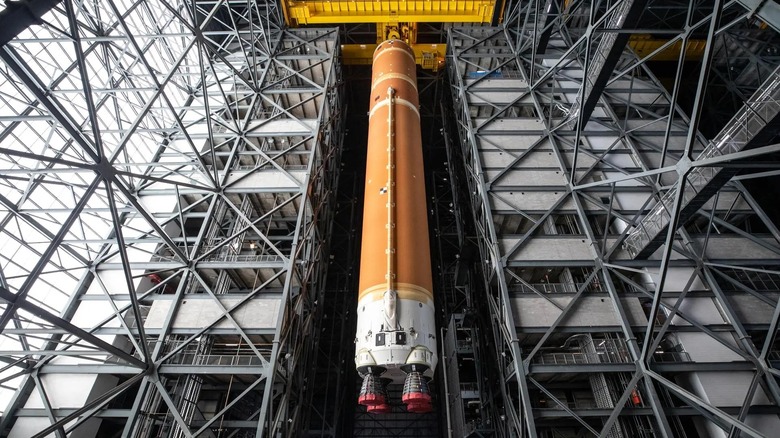
In contrast to many launch vehicles that are assembled horizontally, NASA’s Artemis SLS is uniquely constructed in a vertical position within its expansive Vehicle Assembly Building (VAB). The process begins with the solid rocket boosters, where team members stack the sections one at a time, alternating sides to achieve proper balance as the structure rises. Each segment is meticulously aligned and secured before the next is attached, culminating in two complete boosters, each comprised of five segments along with the necessary forward components and nose cones.
Following the assembly of the boosters, the core rocket, which stands at an impressive 212 feet and holds an enormous capacity of 700,000 gallons of cryogenic propellants, is connected to the system. To integrate the solid rocket boosters with the core stage, the massive structure is maneuvered upright and carefully positioned within the tight space between the boosters to form a secure central spine for the rocket.
Upon completing this intricate assembly, the team proceeded to install the launch vehicle stage adapter, which functions as structural reinforcement while also safeguarding the avionics and electrical components. The construction concluded with the addition of the Upper Stage, known as the Interim Cryogenic Propulsion Stage, and finally, the critical Orion spacecraft along with its launch abort system were affixed to the top of the rocket.
Causes of Artemis Delays
With the completion of the rocket, NASA hopes to initiate the mission as early as February 2026 as part of its ongoing lunar exploration efforts. Unlike Artemis I, which was an uncrewed flight that occurred in 2022, Artemis II will be a crewed mission, featuring a team of four astronauts on a ten-day journey around the moon and back to Earth. While the crew will not land on the moon, this endeavor will represent the greatest distance humans have traveled from our planet in over five decades.
The Artemis II crew comprises Commander Reid Wiseman, Pilot Victor Glover, and mission specialists Christina Koch and Jeremy Hansen. Throughout the mission, the astronauts will assess the performance and operation of the spacecraft as it traverses the deep space environment.
Originally slated for a September 2025 launch, delays arose due to issues with the heat shield on the Orion spacecraft, which was discovered after the successful Artemis 1 mission returned impressive images of the Moon. Although the issue of uneven ablation was not deemed a threat to astronaut safety, NASA chose to err on the side of caution as engineers investigated the problem’s cause.
Although modifications to the heat shield are anticipated for the Artemis III mission, engineers have determined that adjustments to the craft’s re-entry trajectory will suffice in ensuring astronaut safety as the crew descends from nearly 25,000 mph to 325 mph, at which point parachutes can be deployed.