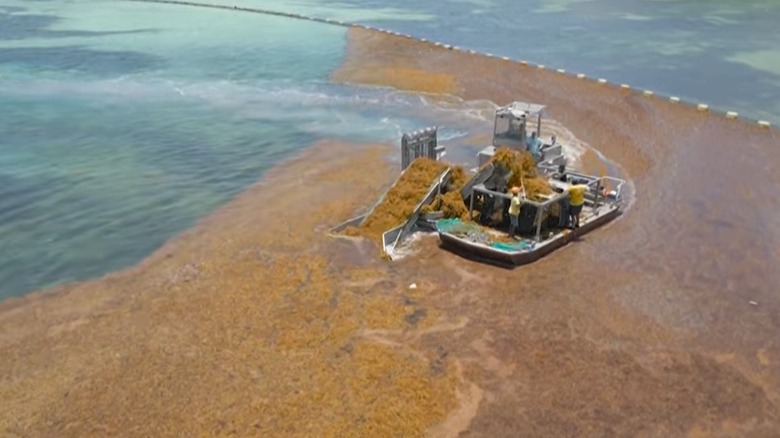
The emergence of a peculiar feature in satellite imagery tends to raise immediate concerns. Recently, scientists issued warnings regarding a brown ribbon that extends longer than a continent—clearly an alarming discovery. But what exactly does this brown stripe in the Atlantic signify? And is it something we should be concerned about?
Satellites have identified a brown band reaching from the West African coastline to the Gulf of Mexico. This unusual entity represents an astonishing 37.5 million tons of pelagic sargassum, a type of brown seaweed that was previously confined to the Sargasso Sea.
In the last 15 years, however, it has been proliferating throughout the Atlantic, which is nearing its “tipping point.” Researchers at the Harbor Branch Oceanographic Institute at Florida Atlantic University have been examining satellite data spanning four decades, chronicling the seaweed’s accelerated growth in the Atlantic. This phenomenon is now referred to as the Great Sargassum Belt, which is not only disturbing marine ecosystems and littering beaches but may also be contributing to the acceleration of global warming.
What is Causing the Brown Seaweed Ribbons in the Atlantic?
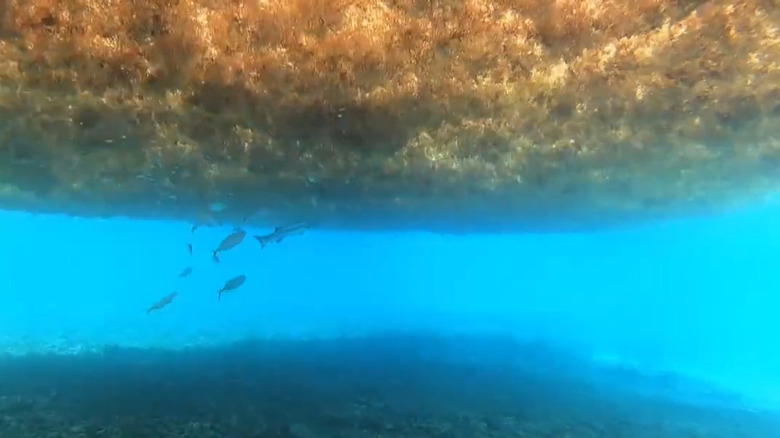
The rapid spread of pelagic sargassum has piqued the interest of scientists who have been investigating this trend since the 1980s. Their research reveals that the nitrogen content in this type of brown seaweed has surged by 55% from 1980 to 2020, with a corresponding 50% rise in the nitrogen to phosphorus ratio.
This indicates that the seaweed isn’t solely relying on natural oceanic processes, such as upwelling, to obtain nutrients. Human activities, including agricultural runoff and wastewater discharge, contribute significantly to the nutrient influx from land.
Pelagic sargassum is conveyed by ocean currents, particularly during flooding of the Amazon River, into the Atlantic. Instead of dying off outside its habitat in the Sargasso Sea, the seaweed flourishes in this new environment due to the enhanced nutrient supply.
The Threats Posed by The Great Sargassum Belt
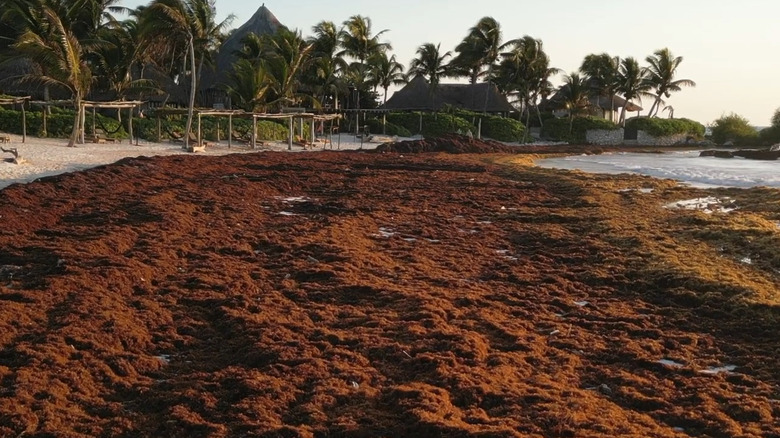
The past few decades have seen a worrying escalation of the robust brown seaweed in the Atlantic, leading to alarming occurrences. According to Dr. Brian Lapointe, lead author and research professor at Florida Atlantic University’s Harmful Algae study, “The nutrient-rich waters have led to high biomass events along the Gulf Coast, which caused mass strandings, expensive beach cleanups, and even the emergency closure of a Florida nuclear power plant in 1991.”
While this type of seaweed is not inherently harmful and provides shelter for over 100 species, including fish, invertebrates, and turtles, its unchecked expansion has thrown marine ecosystems into disarray. Large quantities of sargassum that wash ashore decay, producing toxic hydrogen sulfide gas during the decomposition process. This not only harms coral reefs but also diminishes oxygen levels around beaches and releases greenhouse gases that could potentially disrupt climate feedback mechanisms.
Scientists are actively monitoring the Great Sargassum Belt and cautioning that it’s essential for humans to mitigate nutrient runoff from coastal areas. If overlooked, similar sargassum phenomena could emerge in other regions, resulting in multiple Great Sargassum Belts across oceans. The latest satellite imagery shows that with timely interventions, there is still an opportunity to address climate change effectively.