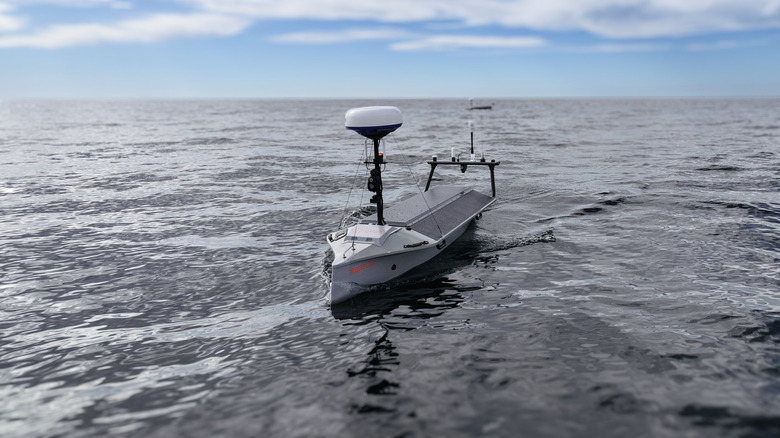
The United States Navy is actively pursuing a shift towards unmanned operations, aiming for half of its surface fleet to consist of unmanned vessels by 2045. As part of this initiative, in 2025, it introduced the USX-1 Defiant, a fully autonomous 180-foot warship. By February 2026, the navy welcomed its new solar-powered drone, the Lightfish, developed by the California-based Seasats.
Weighing in at 305 pounds, the Lightfish drone is engineered for various tasks, including research, surveillance, and security monitoring. Under the navy’s operations, it will facilitate continuous intelligence collection through surveillance and reconnaissance missions across shorelines, harbors, and in deep waters. With a maximum speed of 5 knots (5.75 mph), it’s well-suited for maritime domain awareness activities, addressing concerns like port security, drug trafficking, illegal fishing, and other maritime threats.
Measuring 11.4 feet by 3.4 feet, the Lightfish boasts the capability to remain at sea for up to six months or cover 8,000 nautical miles autonomously. It has a payload capacity of 66 pounds and can be deployed swiftly with as little as one or two personnel. The drone is also transportable in the back of a pickup truck or can be flown on a variety of aircraft. The Lightfish adds to the arsenal of other maritime drones, including an underwater unmanned drone tested by the German Navy in 2025.
The Specifications of the Lightfish
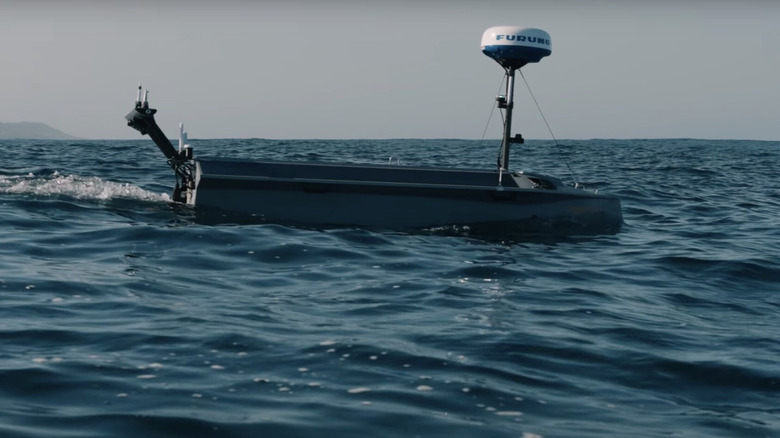
The Lightfish comes equipped with an array of sophisticated technology, including collision avoidance systems, onboard AI, and navigation capabilities that function without GPS. It features five high-definition cameras and multiple backup communication systems such as LTE, Iridium SBD, Iridium Certus, and Starlink. This drone operates on a solar-electric power system supplemented by a methanol fuel cell that can deliver 11 or 28 kWh of power. The ASV utilizes a Torqeedo 1103 electric drive with a weedless propeller comparable to a 3-hp outboard motor. Its weighted keel enables self-righting in rough conditions, even in Sea State 6, where wave heights may reach 20 feet.
Unlike other privately developed USVs, such as the Cardona Marine Group’s Sea-Predator-7, which is armed, the Lightfish is exclusively meant for reconnaissance and surveillance. Its modular design allows for easy maintenance and quick payload adaptability, facilitating swaps within minutes. Despite its advanced technology, Seasats assures that operators only need a brief training period of about five days to control the ASV using browser-based controls.
Seasats also manufactures the Quickfish and Heavyfish ASVs. The Quickfish excels in rapid tactical responses with a top speed exceeding 35 knots (40.28 mph) but can sustain operations for only a month without intervention. It weighs 1,450 pounds and has a 450-pound payload, requiring a trailer for transport. In contrast, the Heavyfish weighs in at 9,000 pounds with a 1,000-pound payload, necessitating specialized vehicles for movement and cranes for launching. It also boasts a six-month operational duration at sea, topping out at 12 knots (13.81 mph).
The Long-Distance Capabilities of Lightfish
In a notable demonstration in June 2024, a Lightfish drone successfully covered approximately 2,500 miles from San Diego to Joint Base Pearl Harbor Hickam in Hawaii over 73 days. Following its triumphant journey, there were plans to extend its mission to Japan, but the endeavor was cut short due to a typhoon that impacted the drone’s operational integrity, caused by a water breach due to a faulty exhaust vent seal.
To validate its endurance further, the Lightfish replicated the journey that commenced from its origin in San Diego. After completing a stop in Hawaii for a demonstration, it continued on past Wake Island and Guam, participating in another exhibition in Okinawa before reaching Japan on July 30, 2025, concluding a remarkable 7,500-mile trans-Pacific voyage over 150 days.
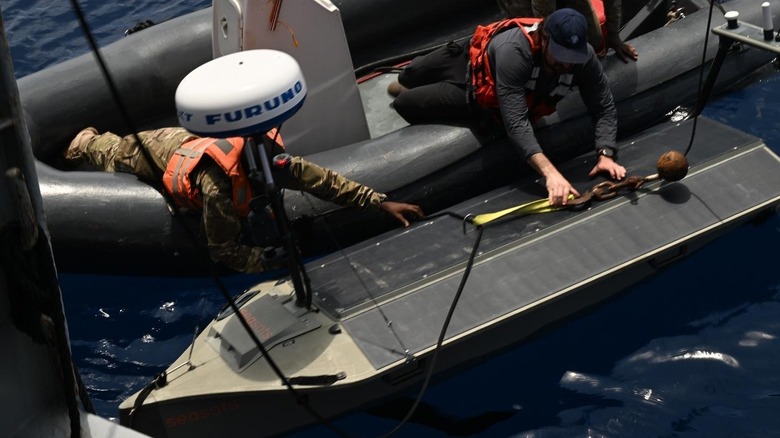
In early February 2026, the Lightfish was put to the test by the U.S. Sixth Fleet, particularly by Commander Task Force (CTF) 66, during Exercise Cutlass Express 2026 in the Western Indian Ocean. This test involved launching the drone from the Seychelles Navy’s SCG auxiliary vessel, Saya De Malha (A605). Coupled with the developments of drones like Lockheed Martin’s Lamprey, the Lightfish is set to enhance maritime security for the U.S. and allied forces.