From time to time, the outer reaches of our solar system showcase just how little we have explored, revealing new mysteries. Recently, a trans-Neptunian object (TNO) was identified by the Subaru Telescope in Hawaii in 2023.
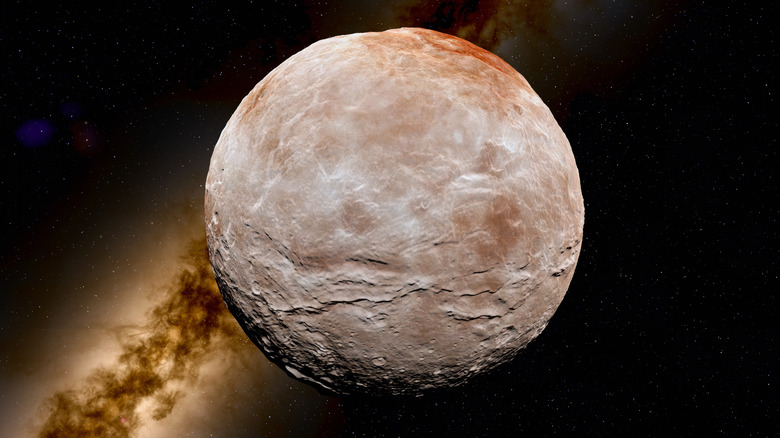
Officially named 2023 KQ14 by a global team as part of the FOSSIL initiative (Formation of the Outer Solar System: An Icy Legacy), it’s nicknamed “Ammonite.” Unlike traditional planets or dwarf planets, this celestial body falls into a unique classification of trans-Neptunian objects known as sednoids.
The closest Ammonite comes to the sun (perihelion) is around 66 astronomical units (AU), which is over twice the distance of Neptune’s perihelion. One AU represents roughly the distance between Earth and the sun, approximately 93 million miles. On average, Ammonite orbits at a distance of about 252 AU from the sun (around 23.4 billion miles). Its size is estimated, based on its reflective sunlight, to be between 137 and 236 miles in diameter, considerably smaller than Pluto.
Given its extraordinary distance, Ammonite takes about 4,000 Earth years to complete one orbit around the sun on its elongated and tilted path. It is the fourth sednoid ever cataloged in the most remote sections of our solar system, following Sedna (discovered in 2003), 2012 VP113, and 541132 Leleākūhonua.
Discovery of another sednoid reignites the Planet Nine hypothesis
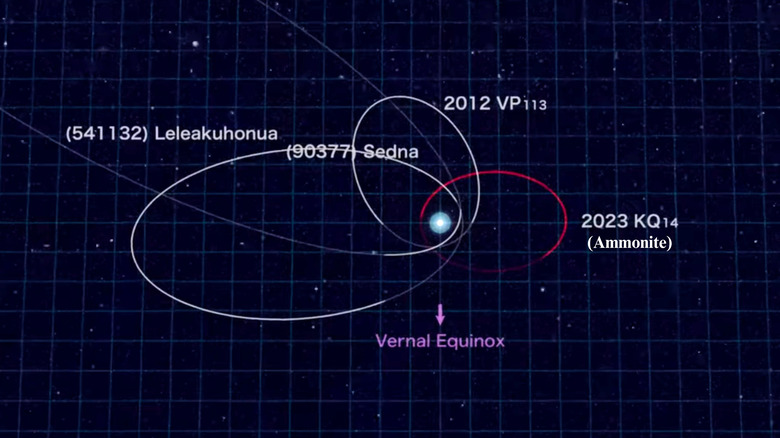
The discovery of sednoids in the distant zones of the solar system bolsters the Planet Nine theory. Proponents of this hypothesis argue that the peculiar distribution of small, icy bodies beyond Neptune, along with their oddly tilted orbits, may be influenced by the gravitational effects of an undiscovered planet lurking past Neptune.
However, Ammonite’s orbit does not conform to the expected patterns seen in other sednoids, as its trajectory is oriented in the opposite direction. Yukun Huang from the Subaru Telescope, who ran simulations on Ammonite’s orbit, stated, “The fact that Ammonite’s current orbit does not align with those of the other three sednoids lowers the likelihood of the Planet Nine hypothesis.”
Despite this, Huang speculates that a ninth planet may have existed at some point in our solar system, which was expelled, leading to the unusual orbits of the sednoids. This theory stems from simulations indicating that closer sednoids had their orbits shaped around 4.2 billion years ago, possibly affected by the gravitational influence of a passing star or the ejection of the ninth planet.
Exploring objects like Ammonite, despite their remote locations, provides astronomers with valuable insights into the history of our cosmic neighborhood; this fourth sednoid represents just a fragment of the overarching mystery.