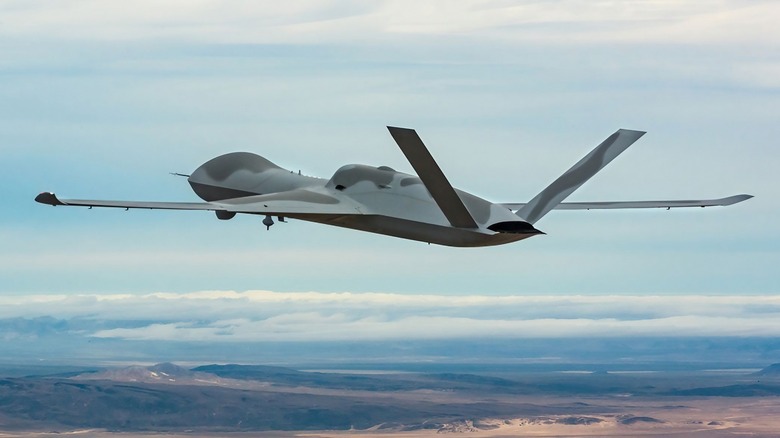
Even the most advanced fighter jet has limitations when it comes to a single pilot managing combat scenarios. With drones taking a more prominent role in aerial warfare, the U.S. Air Force has devised an innovative approach by deploying a fleet of AI-driven wingman drones to support its fighter aircraft. In collaboration with General Atomics, the Air Force has been testing the MQ-20 Avenger drone, which has been showcased as a prototype for future military aircraft. On February 23, 2026, it was announced that the MQ-20 had successfully operated in tandem with an F-22 Raptor during tests conducted earlier that month at Edwards Air Force Base in California. The pilot of the F-22 was able to control the drone using advanced autonomy software paired with a tactical data link, directing it to perform various tactical operations, such as conducting combat air patrols and managing simulated scenarios involving potential threats.
For those unaware, the Air Force has initiated a program named Collaborative Combat Aircraft (CCA), aimed at developing a group of semi-autonomous drones to accompany human-piloted aircraft like the F-22 and F-35. This initiative is designed to enhance flight formations with additional sensors, weapon systems, and operational flexibility, all while minimizing risks to human pilots. The Air Force refers to these CCAs as “attritable”—essentially hinting at their affordability, which allows for potential battlefield loss without heavy consequences. These drones are intended to provide a layer of protection for the piloted aircraft in their vicinity.
“This demonstration highlighted the integration of mission capabilities and the autonomy’s ability to utilize onboard sensors for independent decision-making, as well as executing commands from the F-22,” stated David Alexander, president of General Atomics Aeronautical Systems, in a press release.
Improvements Since the Initial Test
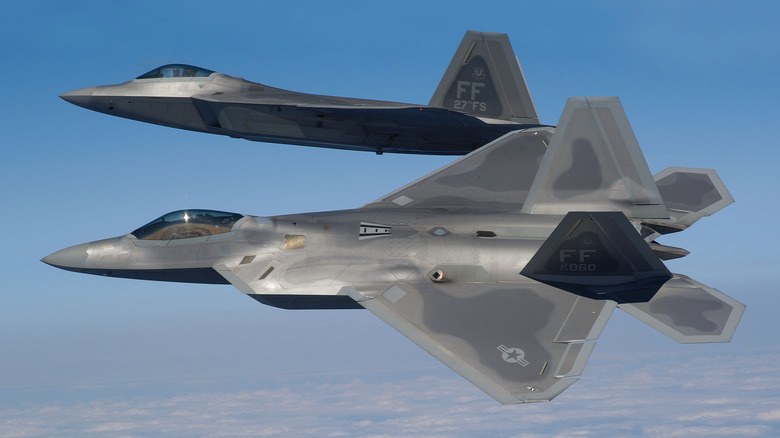
The recent demonstration was an advancement from tests conducted in October 2025, when General Atomics executed a self-funded flight over the Nevada Test and Training Range. During that test, an F-22 pilot utilized a tablet within the cockpit to control an MQ-20 drone. This operation was supported by L3Harris datalinks and Lockheed Martin’s open radio communication systems, marking a significant first for the Raptor. The effort was overseen by Lockheed Martin’s distinguished Skunk Works division.
Notably, the latest February test replaced the tablet control system with government-developed autonomy software integrated directly into the F-22. This upgrade was paired with the Autonodyne Bashi Pilot Vehicle Interface, which facilitated the MQ-20 in performing tactical maneuvers and adjusting its flight path more effectively.
The change is crucial, given concerns raised about the feasibility of using tablets in high-stress combat situations—they notoriously require more attention than traditional controls in vehicles. Managing a tablet while piloting a fighter jet and operating its weapon systems presents additional complications. Recognizing this difficulty, the new interface aims to streamline control for pilots.
As development progresses, the F-22 is expected to be the pioneer aircraft integrated with these capabilities, with projections suggesting readiness by the decade’s close. Following the F-22, the F-35 will likely be next in line, and Boeing’s next-generation fighter, the F-47, is intended to serve as a flying command center that coordinates with such drones right from its design.