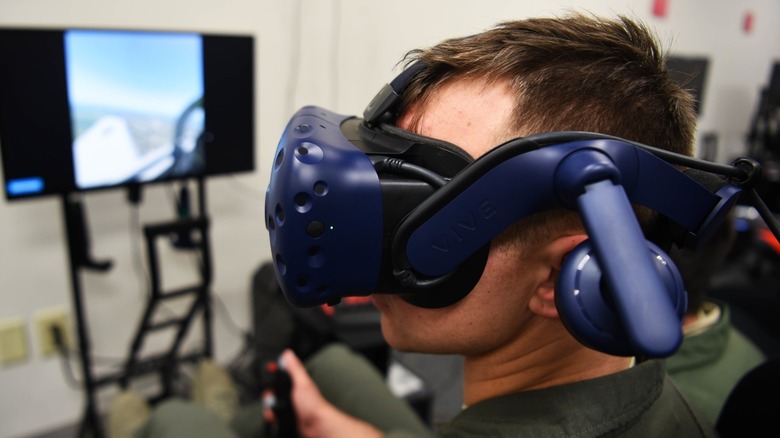
The U.S. military has a well-established history of integrating gaming technology into training programs, driven by its cost-effectiveness and familiarity among recruits. In February 2026, the U.S. Navy introduced a novel approach utilizing virtual reality headsets for onboard and handheld training modules.
Previously, training was conducted at dedicated facilities where sailors traveled to receive training before returning to their units. With the introduction of portable VR training capable of detailed simulations, the Navy is reconsidering its instructional methods. The Naval Air Warfare Center Training Systems Division (NAWCTSD) showcased this capability utilizing budget-friendly handheld gaming PCs and wireless VR devices like the HTC Vive XR Elite.
The initiative aims to meet training goals while minimizing expenses. Currently, the Navy incurs $400 million each year due to traffic and delays in the training process; therefore, facilitating instruction at home bases or on vessels would lead to considerable cost savings. This approach would also eliminate the backlog of sailors awaiting essential training for advancement. To support this, NAWCTSD converted the Multipurpose Reconfigurable Training System (MRTS) 3D® program from large touchscreens into a VR training prototype.
The U.S. Navy’s gaming technology training evolution
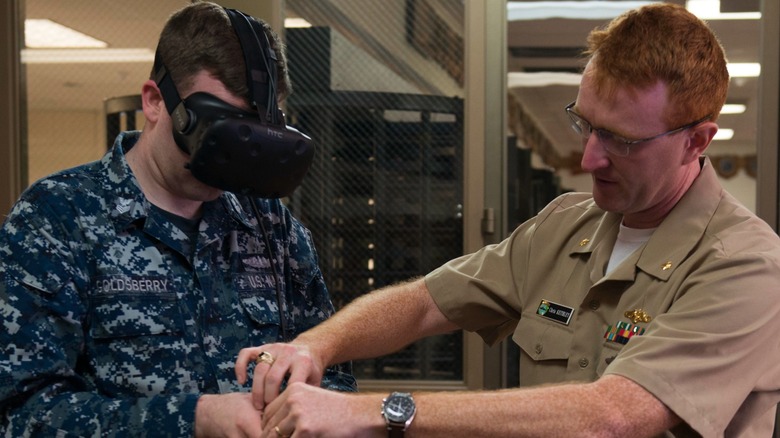
In a showcase of VR’s adaptability for skills training, an NAWCTSD-modified MRTS guided a sailor through the process of repairing a diesel engine on a submarine. Although U.S. submarines are primarily nuclear-powered, advanced attack subs utilize diesel engines as backup power sources and for necessary ventilation in emergencies. During the training session, an instructor’s screen displayed step-by-step guidance while navigating the virtual components of a Los Angeles-class submarine.
Sailors are able to manipulate the instructor’s screen, repositioning it within their view. They interact with the simulation using hand gestures to operate controls, secure bolts, adjust valves, pull levers, and monitor gauges. Errors in the process can be reset for further attempts, with directional arrows leading through tasks, and sufficient room allowing for physical movement between different stations.
The follow-up demonstration involved a handheld gaming console ideal for limited spaces or heightened security needs, employing devices such as the Nintendo Switch and Valve Steam Deck, utilizing familiar gameplay controllers.
The military’s ongoing use of gaming technologies
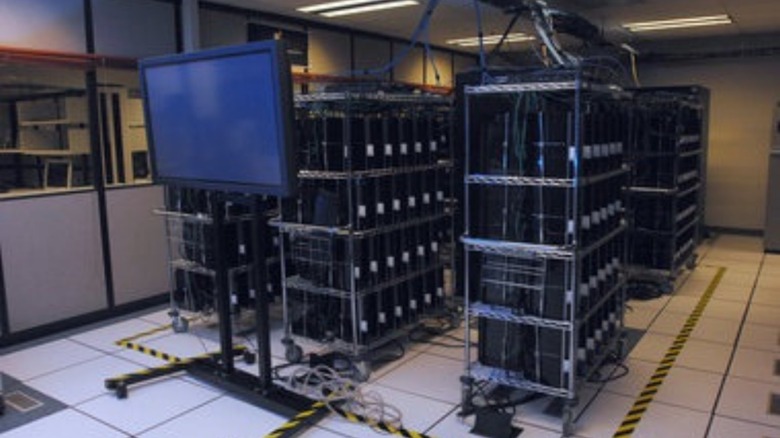
The military’s engagement with gaming technology is not a new phenomenon, dating back to the 1990s when the U.S. Army utilized a Super Nintendo for soldier training. One of the most groundbreaking applications of gaming tech in the military arose when the U.S. Air Force sought to create a powerful supercomputer. The U.S. Air Force Research Laboratory (AFRL) constructed what was then the world’s 33rd most powerful supercomputer using PlayStation 3 consoles.
The AFRL successfully synchronized 1,760 PlayStation 3 units into a system dubbed the “Condor Cluster,” achieving 500 trillion floating-point operations per second. This project led to the development of the Department of Defense’s most efficient interactive system, utilizing a gaming console. While the PS3 was designed with significant capabilities, it’s unlikely that anyone at Sony envisioned its military applications during its creation.
The system not only improved radar functionality but also enabled pattern recognition, satellite image processing, and advancements in artificial intelligence research. The project achieved the creation of an extraordinary supercomputer at a material expense of about $2 million, which is merely 5-10% of the costs that would have been incurred had the Air Force opted for standard component manufacture. Additionally, it consumed only 10% of the power used by comparable computing systems.